Game Buttons. Gaming Options Panel: A Practical Evaluation for UI Design
When designing a user interface for a video game, the visual language of controls, menus, and interactive elements often determines how players perceive and navigate the experience. Among the many graphic assets available, the category commonly described as Game Buttons. Gaming Options Panel, represents a fundamental toolkit for creators. This article offers a balanced evaluation of what this type of asset set entails, why it matters, and how to decide if it serves your project's needs.
What Are Game Buttons and Gaming Options Panels?
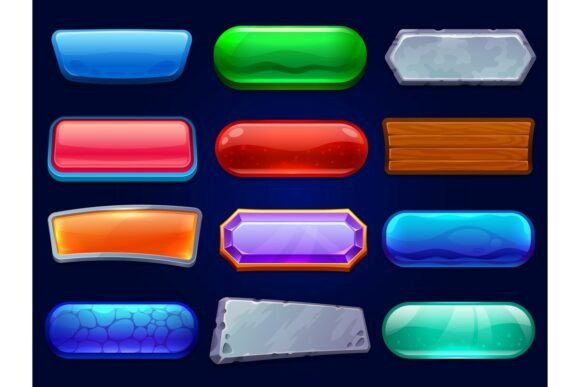
At its core, Game Buttons. Gaming Options Panel, refers to a collection of pre-designed interface components intended for video game user interfaces. These typically include a variety of button states—default, hover, pressed, and disabled—as well as complete panel frames for options menus, settings screens, and navigation hubs. The assets are often presented as a cartoon vector illustration set, which gives them a polished yet stylized aesthetic suitable for many casual, mobile, or mid-core game genres.
The phrase encompasses not just individual buttons but also the structural elements that group them: frames, banners, sliders, toggles, and other interface modules. For a developer or designer, having a unified set like this means less time spent creating UI from scratch and more focus on gameplay mechanics, narrative, or level design.
Why Consider This Type of UI Asset Set?
Interest in Game Buttons. Gaming Options Panel, often arises from practical constraints. Independent developers, small studios, and even hobbyists may lack the resources to commission custom interface artwork. A ready-made vector set provides a consistent visual identity without requiring a dedicated UI artist. Additionally, the cartoon vector style appeals to projects aiming for a friendly, approachable, or whimsical tone—think puzzle games, educational apps, or family-friendly adventures.
The decision to use such a set also reduces friction in prototyping. When testing a game concept, having a functional options panel that looks polished can help stakeholders or playtesters focus on the core experience rather than being distracted by placeholder graphics. This speed of iteration is a significant advantage during early development phases.
Benefits and Practical Strengths
One of the primary benefits of adopting a ready-made Game Buttons. Gaming Options Panel, is the consistency it enforces across the interface. All buttons, panels, and banners share a common aesthetic, which helps players intuitively understand interactive zones. This uniformity extends to color palettes, iconography, and typography, reducing cognitive load during gameplay.
Another advantage is scalability. Because the assets are typically vector-based, they can be resized without loss of quality. This is especially useful when targeting multiple platforms with varying screen resolutions—from mobile devices to desktop monitors to TV displays. The same set can adapt without requiring separate rasterized versions.
Furthermore, many such sets include multiple color variations or theme options. A Gaming Options Panel might come in light and dark themes, or with alternative accent colors, allowing the designer to match the game's mood without reworking each element individually. This flexibility can be a time-saver during polishing phases.
Tradeoffs and Limitations
Despite these advantages, there are important tradeoffs to consider. The most obvious limitation is a lack of originality. Using a widely available asset set means your game's interface may resemble other projects that purchased the same pack. For games competing in a crowded market, this can dilute brand identity. Players might perceive the interface as generic, which can subtly lower perceived production value.
Additionally, Game Buttons. Gaming Options Panel, sets are often designed to be broadly appealing. This generality means they may not align perfectly with a specific game's theme. For example, a sci-fi action game with dark, neon-heavy aesthetics might clash with a bright, rounded cartoon panel style. The asset set imposes a visual direction that may restrict the creative vision rather than enhance it.
Another consideration is customizability. While vector assets are editable, modifying them requires design software skills. If your team lacks a graphic designer, you may be stuck with the exact look of the original set. Some packs also come with licensing restrictions—such as limits on commercial use, redistribution, or modifications—so reading the terms carefully is essential.
When Is a Pre-Made UI Set a Strong Fit?
A pre-made Game Buttons. Gaming Options Panel, set is an excellent choice in several specific scenarios. If you are building a prototype for a game jam or a proof-of-concept demo, speed outweighs uniqueness. A polished panel set can make the prototype look more professional, which can be critical for attracting investor attention or winning competitions.
It is also a good fit for solo developers or micro-studios with limited budgets. Instead of spending weeks designing and implementing a custom UI, you can integrate an existing set within hours. This frees up time for game mechanics, testing, and content creation—areas that often have a greater impact on player enjoyment.
For genres where interface familiarity is valued—such as casual puzzle games, match-three titles, or educational software—the standard cartoon vector aesthetic works well. Players in these genres often expect a friendly, easy-to-navigate interface, and a pre-made set delivers that reliably.
When Alternatives May Be Worth Considering
There are situations where a custom UI or an alternative approach is preferable. If your game targets a niche audience with a very specific visual identity—like a horror game, a hyper-realistic simulation, or an avant-garde art project—a generic cartoon panel set will likely feel out of place. In such cases, investing in a custom-designed interface or commissioning assets from a freelance artist is the better path.
Another consideration is accessibility. Pre-made sets may not include states for people with visual impairments, such as high-contrast modes, large text sizes, or screen-reader-friendly labels. If your audience includes players who rely on assistive technologies, you might need to customize extensively or start from a more accessible foundation.
Performance is also relevant. A vector-based set can be efficient, but if a pack includes many high-resolution textures or complex layered frames, it may impact load times on lower-end devices. For mobile games with tight memory constraints, a lighter custom approach could be more effective.
Practical Decision-Making Insights
To determine whether Game Buttons. Gaming Options Panel, aligns with your goals, start by evaluating your project's requirements. List the non-negotiable elements of your interface: expected platforms, target audience, visual tone, and accessibility needs. Then compare these against the features offered by the asset set.
Consider doing a small integration test. Download a sample version of the set (if available) and implement one screen—say, the main menu or options panel. Assess how it looks in context, how easily it can be color-matched to your existing assets, and whether the buttons respond well to user interactions. This hands-on trial often reveals compatibility issues that a preview image cannot.
Another useful step is to estimate the total time savings. Calculate how many hours it would take to design custom buttons and panels for your game, then compare that to the time needed to customize the pre-made set. If the savings are significant and your visual requirements are flexible, the asset set is a compelling choice. If the gap is small, custom design may offer better long-term value.
Finally, think about future-proofing. A Gaming Options Panel set that includes multiple themes or color variants gives you room to iterate without redoing the entire UI. If you anticipate major visual changes, such flexibility is a strong advantage.
Conclusion: Matching the Tool to the Task
Game Buttons. Gaming Options Panel, as a concept, represents a practical resource for game developers who need a reliable, consistent, and visually polished interface without the overhead of custom creation. Its strengths—speed, consistency, scalability, and thematic variety—make it ideal for prototyping, small teams, and casual game genres. However, its limitations in originality, specificity, and accessibility mean it is not a universal solution.
The most effective decision comes from aligning the asset set's strengths with the specific demands of your project. By evaluating your game's visual identity, audience expectations, development timeline, and technical constraints, you can determine whether a pre-made set is the right foundation or whether a custom approach is worth the investment. In either case, understanding what Game Buttons. Gaming Options Panel, offers and where it falls short will help you make a more informed, strategic choice for your game's user experience.