Play Win Repeat: Why This Retro Gaming Shirt PNG Deserves a Spot in Your Creative Workflow
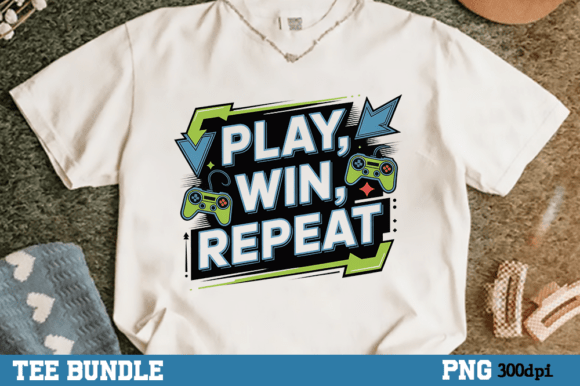
If you have spent any time browsing design assets or print-on-demand mockups recently, you have likely encountered the phrase Play Win Repeat. It captures something simple about gaming culture—a loop of action, challenge, and satisfaction that resonates with players of all ages. But when that phrase appears on a Retro Gaming Shirt PNG, it becomes more than a slogan. It becomes a versatile asset for creators, small business owners, and anyone building a brand around nostalgia and playfulness.
The file you are looking at—a single PNG measuring 4500×5400 pixels at 300 dpi—promises print-ready quality. That is a solid foundation. But how you use it, where you place it, and what you assume about its capabilities can make the difference between a polished final product and a frustrating outcome. Let us walk through what this design actually offers, where people tend to go wrong with assets like this, and how you can get the most out of it without wasting time or money.
What Play Win Repeat and This Retro Gaming PNG Actually Deliver
At its core, this PNG is a transparent-background graphic file built for flexibility. The dimensions—4500 by 5400 pixels at 300 dpi—mean it will scale cleanly for most print applications. You can drop it onto a t-shirt mockup, size it for a phone case, or use it as the centerpiece of a poster without worrying about pixelation. The transparent background saves you the headache of cutting out a white box later.
The design itself leans into retro gaming aesthetics: pixel-inspired typography, bold colors, or chunky lettering. It evokes arcade cabinets, early console menus, and the kind of phrase that feels at home on a worn-in cap or a canvas tote. For anyone targeting an audience aged 20 to 50—people who grew up with Mario, Sonic, or Pac-Man—this visual language lands immediately. It signals familiarity without trying too hard.
Where the Misunderstandings Start
Despite the apparent simplicity, several common mistakes trip up both beginners and experienced creators when working with a file like this. Let us address them directly so you can avoid the frustration.
Mistake One: Assuming a Single PNG Solves Every Layout Problem
One of the most frequent misunderstandings about a Retro Gaming Shirt PNG is that you can simply drop it onto any product at full size and call it done. The file is 4500×5400 pixels. That is large enough for many applications, but product dimensions vary wildly. A standard t-shirt print area might be 12 by 14 inches. A phone case is far smaller. A notebook cover has its own ratio.
If you place this full-size PNG onto a product without resizing or centering it within the print area, you risk cropping off the edges or ending up with a design that looks comically oversized. Worse, if you scale it down too aggressively without maintaining aspect ratio, the text may become illegible or lose its retro charm.
How to avoid it. Before you drag that PNG into your design software, measure your print area. Know the maximum safe zone for your product. Then resize the design proportionally so it fits comfortably within that zone. Leave at least half an inch of breathing room from edges to avoid cutoff during production. Test the scaled version at actual size on screen—zoom to 100 percent—and ask yourself whether the text reads clearly at a glance.
Mistake Two: Ignoring Color Mode and Profile Settings
This is the silent killer of print projects. The PNG you download is likely in RGB color mode. That is fine for screens—websites, social media graphics, digital banners. But most print-on-demand services and commercial printers expect files in CMYK. If you submit an RGB PNG for a t-shirt or a poster, the colors will shift during conversion. Bright retro reds can turn muddy. Neon greens flatten out. The whole retro vibe gets muted in a way that feels disappointing.
How to avoid it. Check your workflow early. If your intended use is exclusively digital—social media posts, blog headers, digital backgrounds—RGB is perfectly fine. The file works as-is. But if you plan to print on a physical product, convert the file to CMYK in your graphics software before you start laying out your design. Alternatively, provide your print provider with a version they can handle. Many services accept RGB files and convert them automatically, but you lose control over the final color. For critical projects, do the conversion yourself and soft-proof the result.
Also watch out for hidden color profiles. A different profile embedded in your PNG or project file can produce unpredictable shifts. Stick with sRGB for digital uses and a standard CMYK profile like US Web Coated SWOP v2 for print. If you are unsure, ask your printer what profile they recommend.
Mistake Three: Overlooking Licensing and Usage Rights
A Play Win Repeat Retro Gaming Shirt PNG is a commercial asset. You are purchasing a file with the expectation that you can use it for products, branding, or creative projects. But not all PNG assets come with the same permissions. Some allow unlimited commercial use. Others restrict the number of products you can sell, limit the industries you can work in, or prohibit use in logo designs.
Beginners sometimes assume that buying a file means they own it outright. That is rarely the case. You own the right to use it within certain boundaries. If you build an entire brand identity around this design and later discover the license restricts resale of digital products, you could be forced to redesign everything.
How to avoid it. Read the terms before you download. Look for clear language about commercial use, print-on-demand, and redistribution. If the product page says you can use it for POD products, save a screenshot of that statement for your records. If the license is vague, reach out to the seller. Most reputable creators are happy to clarify. And if you plan to use the design in a logo or as a central brand element, consider whether you want something exclusive. A widely available PNG may appear on dozens of other products. That is fine for a fun t-shirt design, but less ideal for a business you hope to differentiate.
Mistake Four: Neglecting the Background and Layering Needs
Transparent PNGs are convenient, but they are not magic. If you place this design over a dark product—a black t-shirt, a navy phone case, a dark notebook cover—the transparent areas show whatever is behind them. That is the point. But if the design contains thin lines, light colors, or intricate details, they can disappear against a dark background.
Similarly, if you layer the PNG over a busy pattern or a photo, the retro lettering may become hard to read. The contrast that looked perfect against a white screen in your editing software can vanish when viewed in context.
How to avoid it. Test the design against the actual background color or pattern you intend to use. Do not rely on a white canvas alone. Drop a dark rectangle behind the PNG in your software and adjust the contrast or add a subtle outline or drop shadow if needed. For t-shirt designs, consider whether a white or light garment lets the design pop more effectively. If you are set on a dark product, look for a version of the design that includes a white or light-colored outline to maintain legibility.
Mistake Five: Using the PNG at the Wrong Resolution for the Product
The file is 300 dpi at 4500×5400 pixels. That is excellent for most print jobs. But not all products require that resolution. A large wall art piece might benefit from every pixel. A small sticker or a button pin might not need such a massive file. Conversely, some products—like oversized banners or large-format prints—may require even more resolution than this file provides.
Pushing the design beyond its native size will introduce softness. Using it at too small a size is inefficient but harmless. The real mistake is assuming that one resolution fits every use case perfectly.
How to avoid it. Match your file resolution to your output size as a starting point. For a standard t-shirt print at 12×14 inches, 300 dpi is ideal. This PNG covers that easily. For a small phone case at roughly 3×6 inches, you can even afford to downsample. For a 24×36 inch poster, this file gets you to about 150 dpi at full size—acceptable for viewing at arm's length but not crisp up close. If you need larger, consider whether the design works as a vector or whether you can upscale it with software that preserves edges.
Practical Steps Before You Buy or Use This Design
Before you add this Play Win Repeat Retro Gaming Shirt PNG to your cart or drop it into your next project, run through a short checklist.
- Confirm your intended product or medium. Digital use, print-on-demand, wall art, or branding all require slightly different preparation.
- Check the license terms for commercial use and POD specifically.
- Open the PNG in your software and verify that the transparent areas are genuinely transparent. A quick check against a colored background reveals any hidden white pixels.
- Test the design at the size you plan to use. Scale it, position it, and view it at 100 percent zoom. Read every letter.
- Convert your final file to the correct color mode for your output. RGB for screens, CMYK for print.
Taking ten minutes to go through these steps saves you from ordering a batch of t-shirts only to discover the text is too small or the colors look wrong.
How This PNG Fits Into a Broader Creative Strategy
A single design file like this one is not a full brand. It is a building block. You can pair it with other retro elements, custom backgrounds, or complementary typography to create a cohesive look. Many creators use assets like this as a starting point for a product line—t-shirts, mugs, stickers, and bags that all share the same visual thread.
The "Play Win Repeat" phrase itself carries weight beyond gaming. It works for motivational content, habit tracking, fitness branding, or anything that emphasizes persistence and reward. That versatility is part of why a retro gaming shirt PNG appeals to such a broad audience. It is niche enough to feel specific, but broad enough to adapt.
If you are building a small business around nostalgia or gaming culture, consider building a small collection around this design. Offer it on a few products to test demand. Use the same PNG for your social media banners to create consistency. Repurpose it for digital backgrounds or planner stickers. The same file that works for a shirt also works for a notebook cover if you scale and position it thoughtfully.
What You Get and What You Still Need to Do
The download includes one PNG file at 4500×5400 pixels, 300 dpi, ready for print. That is a strong starting asset. But the final quality depends on your decisions. The file does not include mockups, templates, or pre-built layouts. You still need to position it, color-manage it, and pair it with appropriate backgrounds or products. The creative work is yours.
The advantage of starting with a high-resolution transparent PNG is that you skip the time-consuming steps of designing from scratch or cleaning up a low-quality image. You begin ahead. From there, your choices about sizing, color mode, background contrast, and licensing determine whether the result looks professional or amateur.
If you are new to print-on-demand or digital design, treat this file as a learning tool. Experiment with different products. Test color conversions. Compare how the design reads on light versus dark backgrounds. Each attempt teaches you something that applies to future projects.
Final Thoughts on Getting It Right
Working with a Play Win Repeat Retro Gaming Shirt PNG can be straightforward and rewarding. The design already carries the cultural resonance and visual style that appeals to your audience. Your job is to handle the technical details so nothing distracts from that appeal.
Pay attention to the print area, the color mode, the background contrast, and the licensing terms. Test before you commit to a large order. And remember that a single file can serve many purposes if you prepare it correctly. Whether you are making a shirt for yourself, launching a small product line, or adding flair to your social media presence, this PNG gives you a solid foundation. Build on it thoughtfully.
If you found this breakdown helpful and want to keep it within reach for future projects, please FAVORITE our store or listings so you can find us again easily. You will get exactly what is described: one PNG file, print-ready at 4500×5400 pixels and 300 dpi. From there, the possibilities are yours to explore. Use it for wall art, t-shirts, fabrics, phone cases, homeware, patterns, graphic design projects, websites, shop banners, company branding, social media content, digital backgrounds, notebooks, planners, stationery—or anything else you can dream up. Unleash your creativity and make it your own.