The Floating Gaming Desk Brain Tumbler: A Design Exploration of Neural Aesthetics and Digital Craftsmanship
Origins of the Floating Gaming Desk Brain Tumbler Concept
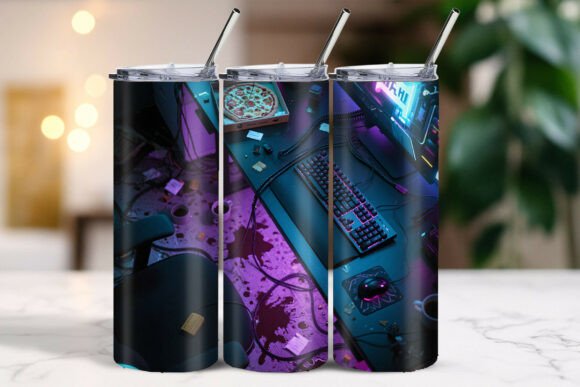
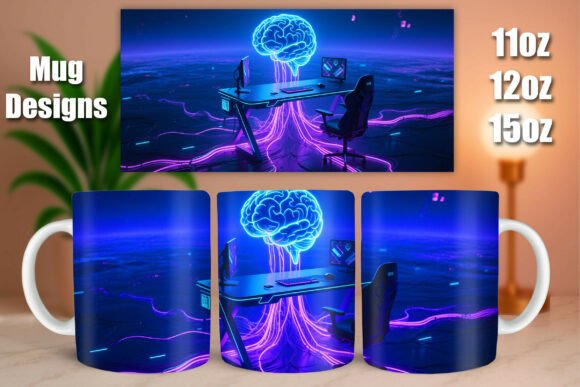
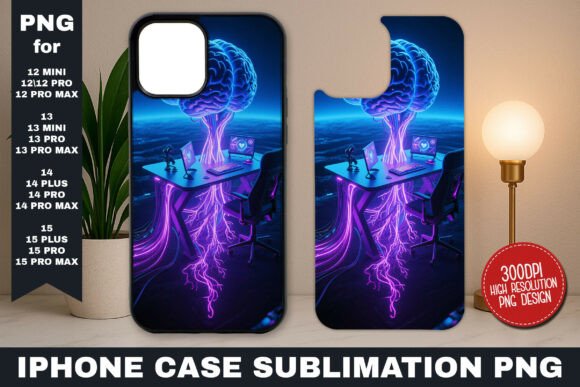
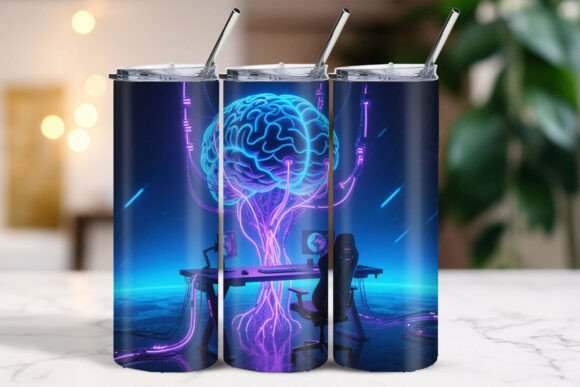
The Floating Gaming Desk Brain Tumbler design began as a creative experiment in merging two visually rich domains: the organized chaos of a gaming workstation and the abstract, organic forms of neural networks. The result is a tumbler wrap that feels simultaneously futuristic and familiar. The floating desk element introduces a sense of weightlessness, while the brain motif suggests cognition, strategy, and the mental focus required in competitive gaming. This juxtaposition creates a product that appeals not only to gamers but also to those who appreciate conceptual design in everyday objects.
When developing the visual language for this wrap, the aim was to avoid literal depictions in favor of stylized, layered compositions. The desk itself appears suspended, with peripherals, screens, and cables arranged in a way that defies gravity. The brain element is woven through the composition, sometimes as a central motif, other times as a subtle texture running along the edges. This dual approach ensures the design remains versatile across different tumbler shapes and sizes.
The Creative Workflow: AI Generation Meets Manual Refinement
Every Floating Gaming Desk Brain Tumbler listing is built on a foundation of AI-generated imagery that is then meticulously edited and refined in Photoshop. This hybrid process deserves attention because it represents a growing trend in digital product design. The AI handles initial pattern generation, color palette exploration, and the creation of complex, surreal juxtapositions that would be time-intensive to build from scratch. However, raw AI output rarely meets the precision requirements of a commercial product wrap.
The Photoshop refinement stage addresses alignment, resolution consistency, edge clean-up, and color balance. Elements that appear too noisy or fragmented are smoothed out. The floating desk components are re-layered to ensure they read clearly at both full size and when scaled down. The brain textures are adjusted for contrast so they remain visible against the tumbler's background without overwhelming the overall composition. This human-in-the-loop approach ensures the final design retains the novelty of AI-generated art while meeting the professional standards expected in a digital download.
Why This Workflow Matters for Designers and Creators
For creators who purchase this wrap, understanding the underlying workflow provides insight into how to adapt or remix the design. The AI generation phase offers a starting point that can be customized further. The Photoshop edits demonstrate what is possible when machine learning outputs are treated as raw material rather than finished products. This listing essentially provides a case study in modern design production—one that balances automation with art direction.
Technical Specifications and File Formats
The Floating Gaming Desk Brain Tumbler download includes two essential file formats: 1 Straight PNG File and 1 Tapered PNG File. This dual-format approach addresses the two most common tumbler geometries found in the market. Straight tumblers have uniform diameter from top to bottom, while tapered tumblers narrow slightly toward the base. Providing both formats eliminates the need for end users to manually warp or distort the design to fit their chosen vessel.
- Straight PNG File: Ideal for standard cylindrical tumblers with parallel walls. The design wraps evenly without distortion, maintaining the floating desk perspective and brain texture across the full surface.
- Tapered PNG File: Designed for tumblers that narrow at the bottom. The artwork is pre-adjusted to compensate for the conical shape, so the brain motifs and desk elements remain proportionally consistent even as the circumference changes.
Dimensions and Resolution Details
The files are delivered at 9.3 × 8.2 inches with a corresponding pixel dimension of 2790 × 2460 pixels. This resolution, combined with 300 dpi, ensures the wrap prints sharply on both consumer-grade inkjet printers and professional sublimation setups. The pixel density is sufficient to capture fine details in the brain textures and the subtle gradients of the floating desk lighting. Users working with larger tumblers can scale the PNGs upward slightly without introducing visible pixelation, thanks to the generous base resolution.
Practical Applications and Real-World Use Cases
The Floating Gaming Desk Brain Tumbler design is not limited to a single audience. Its visual themes make it suitable for several distinct use cases:
- Personal Gaming Accessories: Gamers who spend long hours at a desk can use this wrap to personalize their drinkware, creating a cohesive aesthetic with their gaming setup. The brain motif resonates with the strategic thinking required in competitive play.
- Streamer Merchandise: Content creators looking for unique merchandise can apply this design to tumbler lines sold to viewers. The floating desk imagery ties directly to streaming culture, where the desk setup is often a focal point of the broadcast.
- Workspace Branding: Tech companies or co-working spaces focused on productivity and cognitive performance can use the design for branded promotional items. The combination of desk and brain themes aligns with messages of focus, efficiency, and innovation.
- Educational and Research Settings: Neuroscience labs, psychology departments, or STEM outreach programs may find the brain motif appropriate for conference giveaways or lab-themed merchandise, with the desk element representing the research environment itself.
- Custom Gift Production: Small-batch crafters who produce personalized tumblers can offer this design to customers who appreciate surreal, tech-inspired art. The AI-generated roots of the design also appeal to buyers interested in emerging creative technologies.
Customization and Scaling Considerations
While the provided PNGs are ready to print, users should be aware of a few practical factors. The listing explicitly notes that sizes are approximate and can be scaled up slightly or down as needed. Scaling down generally preserves detail without issue. Scaling up beyond 10–15 percent may begin to soften the fine neural textures, though the overall composition typically remains intact. Users printing on larger vessels, such as 30-ounce tumblers, should test a small proof print before committing to full production.
The design's layered composition actually benefits from slight scaling adjustments. When enlarged, the floating desk elements gain visual prominence, and the brain textures spread into broader, more abstract patterns. When reduced, the design becomes tighter and more intricate, with the neural lines resembling delicate etching. This flexibility makes the wrap suitable for both bold, statement-sized tumblers and smaller, more subtle drinkware.
Color Accuracy and Digital Display Considerations
A critical note accompanies every Floating Gaming Desk Brain Tumbler listing: colors may vary slightly due to screen differences. This is an inherent reality of digital product design. The tumblers used in mockup photos are for demonstration only—they illustrate how the wrap could look when applied but do not guarantee an identical match on every substrate and printer combination.
For best results, users should calibrate their monitors if possible and request a physical proof from their print provider before running a full batch. Sublimation printing, in particular, can shift colors based on temperature, pressure, and the coating of the tumbler itself. The design's color palette has been constructed with some tolerance for these variables, but testing remains the surest path to satisfaction. The PNG files themselves are exported in sRGB color space, which is widely compatible with consumer and commercial printing workflows.
Understanding the Digital Download Nature of This Product
This listing is a digital download, meaning no physical items are shipped. The buyer receives the PNG files and is responsible for printing and applying the wrap to their chosen tumbler. This model offers advantages: no shipping delays, no inventory management, and the ability to print on demand. It also places the responsibility for print quality on the purchaser. Users should ensure they have access to a suitable printer—either at home through sublimation or transfer paper, or via a third-party print service.
The digital nature also means the files can be stored and reused. A single purchase allows the buyer to print the wrap multiple times, for personal use or small-scale gifting. Commercial resale of the digital files themselves is not permitted under typical terms, but using the design to create physical products for sale is generally allowed, provided the buyer respects the intellectual property guidelines outlined in the listing.
AI-Generated Content and Intellectual Property Context
The listing includes a clear statement: This is AI Generated, and if there are any similarities to copyrighted material, it is by pure coincidence and can be removed instantly when requested. This transparency is important in the current creative landscape. AI-assisted design tools are evolving rapidly, and the boundaries between inspiration, derivation, and coincidence remain subjects of active discussion. By explicitly acknowledging the AI role, the seller establishes a foundation of honesty with buyers.
From a practical standpoint, the Photoshop refinement stage significantly reduces the likelihood of unintended similarities. The manual editing process transforms generic AI outputs into a specific, directed design. The floating desk composition, the particular arrangement of neural pathways, and the color grading applied in post-production all contribute to a unique visual artifact. Buyers can use the design with confidence that it has been reviewed and polished by human eyes.
If for any reason a resemblance to existing work is identified, the seller's willingness to remove it promptly demonstrates a commitment to ethical practice. This responsiveness is a hallmark of responsible AI-assisted product creation and aligns with the broader industry move toward clearer attribution and accountability in generative design.
Why This Design Resonates Across Audiences
The broad appeal of the Floating Gaming Desk Brain Tumbler lies in its symbolic flexibility. For gamers, it represents the mental engagement of gameplay and the physical space where that engagement happens. For professionals, it evokes the idea of a clear, organized mind at work. For creators, it stands as an example of how AI and traditional editing can coexist. For hobbyists, it offers a ready-to-use design that requires no additional artistic skill to apply.
This versatility is intentional. The design avoids overly specific branding or text, allowing each user to project their own meaning onto the imagery. The floating desk can be any desk; the brain can be any mind. This openness makes the wrap suitable for a wide range of contexts, from a teenager's bedroom gaming station to a corporate office breakroom. The AI-generated origin adds a layer of contemporary relevance, aligning the product with current conversations about technology, creativity, and automation.
Final Observations on the Design Process and Utility
Working with a Floating Gaming Desk Brain Tumbler design reveals something about the current moment in digital product creation. The combination of AI generation and Photoshop refinement produces results that neither method could achieve alone. The AI contributes novelty, speed, and the ability to explore visual combinations that might not occur to a human designer. The Photoshop stage contributes precision, polish, and the kind of fine-tuned adjustments that separate a usable product from a rough concept.
For the end user, the value is straightforward: a ready-to-print wrap that has already been through a rigorous design pipeline. The straight and tapered formats cover the most common tumbler shapes. The high resolution supports professional-quality printing. The design itself carries visual interest that stands up to repeated viewing. Whether the goal is to enhance a personal collection, launch a merchandise line, or simply explore what AI-assisted design can offer, this wrap provides a practical and aesthetically engaging starting point.
The Floating Gaming Desk Brain Tumbler represents a convergence of technology, art, and everyday utility. It is a product that acknowledges its own creation process while remaining focused on the user's experience. From the floating desk that defies gravity to the brain motifs that invite contemplation, every element serves both a visual and conceptual purpose. For anyone interested in where digital design is heading, this wrap offers a tangible example of the possibilities inherent in the current creative landscape.